


Basement Wall Sealing in Boulder: Stop Damp Walls Before They Get Worse
Boulder sits where the Flatirons meet the plains, and that geography drives how water behaves around your foundation. Heavy clay and shale soils swell with every storm, then shrink under the dry mountain sun, and foothill runoff sheds fast off the slopes after summer hail and rain. In Whittier and Mapleton Hill, 1900s bungalows often have stone or early block lower levels that wick moisture straight through the mortar. Out east in Martin Acres, 1950s ranches sit on low foundations with partly finished basements. Basement Wall Sealing in Boulder starts with an honest read of which problem you actually have: surface dampness that a sealer can handle, or hydrostatic pressure that a sealer will only hide until the next wet spring. We prep the wall, remove efflorescence, and apply penetrating or membrane sealers where they belong. If the water is coming from below or through the cove joint, we tell you that too. Call (970) 670-8043 for a free basement inspection and a straight answer.
Why Damp Basement Walls Are a Boulder Problem, Not a Generic One
Boulder's freeze-thaw swings are brutal on below-grade walls. Water enters a hairline crack or porous block, freezes overnight, expands, and widens the opening before it thaws. Repeat that cycle through a Front Range winter and a wall that was merely damp in October is weeping by March. The heavy glacial clay soil holds that water against the foundation instead of letting it drain away, so the wall stays saturated long after the storm passes.
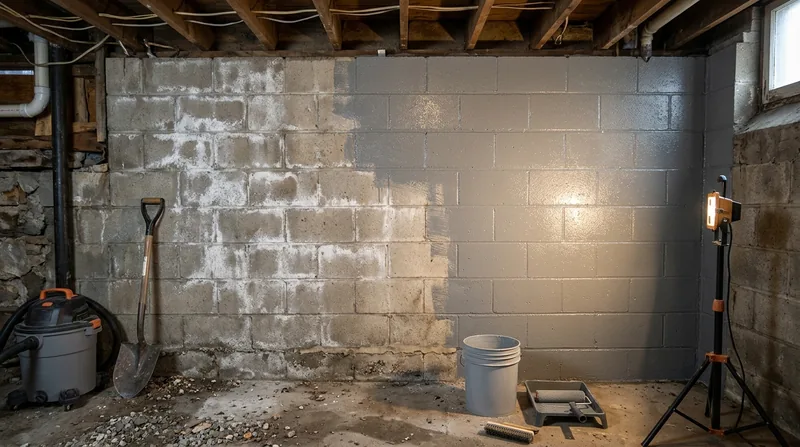
- Efflorescence, the white chalky bloom on block and mortar, tells you water is moving through the wall and evaporating on the inside face.
- A musty basement smell that gets stronger after rain usually points to damp masonry feeding mold growth on framing and stored materials.
- Paint that bubbles or peels on a lower wall is a sign of moisture pushing from behind, not a paint failure.
- Window wells in Gunbarrel and Niwot walkout basements collect hillside runoff and drive it straight against the wall.
- Older stone foundations in Goss-Grove and Whittier have mortar joints that erode and need repointing before any sealer goes on.
If you see any of these, the wall is telling you something. Sealing may be the right first step, or it may be a bandage over a drainage problem.
Key info: A 1920s foursquare on Mapleton Hill with white efflorescence and damp block is a good candidate for sealing after repointing. The same wall with water pooling at the cove joint after a June hailstorm needs interior drainage first, because no sealer holds back hydrostatic pressure.
For official guidance on what work requires a permit in the City of Boulder, check the city building permit portal before you schedule anything structural.
How We Seal a Basement Wall in Boulder, Step by Step
We do not roll sealer onto a dirty, wet wall and call it done. The prep is the job. On a typical Boulder County basement, we start by finding the source: grading, downspout discharge, window well drainage, or a crack that needs injection before any coating goes on. Then we work the wall itself.
- We inspect the interior and exterior face, note crack locations, and check for active seepage versus old staining.
- We remove efflorescence and loose mortar with wire brushes and a masonry cleaner, then let the wall dry to a readable moisture level.
- We repoint or patch deteriorated mortar joints on older stone and block walls so the sealer has a sound substrate.
- We inject active cracks with epoxy or polyurethane before sealing, because a moving crack will reopen a rigid coating.
- We apply a penetrating sealer for damp masonry or a membrane coating where a film is appropriate, following the manufacturer's coverage rate.
- We correct the water source at grade: downspout extensions, regrading, and window well drainage so the wall is not re-wetted from above.
Skipping any of these steps is how homeowners end up resealing the same wall every two years.
Key info: On a 1960s split-level in Martin Acres, we found the damp wall was fed by a downspout dumping at the corner. We extended the discharge, sealed the block, and the wall stayed dry through the next spring melt. On a Superior poured-wall basement, the seepage was a shrinkage crack, so foundation crack repair with injection came before any sealer.
Sealing Approaches We Use and When Each One Fits
There is no single product that solves every damp wall. The right choice depends on the wall material, whether the moisture is vapor or liquid, and whether the wall moves. Here is how we match the approach to the condition.
| Approach | Description | Best for |
|---|---|---|
| Penetrating sealer | Sinks into block and mortar pores and reacts to form a water-repellent barrier inside the masonry. | Damp block walls with efflorescence and no active running water. |
| Membrane coating | A flexible film applied to the interior face that bridges hairline cracks and resists vapor movement. | Poured walls with minor seepage and stable, non-moving cracks. |
| Crack injection first | Epoxy or polyurethane injected through ports to fill the full depth of an active crack before sealing. | Walls with a visible crack that leaks after rain or shows movement. |
| Parging and repointing | Replacing eroded mortar and applying a fresh parge coat to stone and old block walls. | Pre-1940s stone and block foundations in Whittier and Mapleton Hill. |
| Drainage correction | Regrading, downspout extensions, and window well drainage to stop water from reaching the wall. | Walls that stay wet because of roof discharge or hillside runoff. |
We often combine two or three of these on one wall. The goal is a dry wall, not a product sale.
Basement Wall Sealing Cost in Boulder: What to Expect
Most interior wall sealing jobs in Boulder start around From $1,500 for a single damp wall with straightforward prep. That figure covers cleaning, efflorescence removal, and a penetrating or membrane sealer on a wall that is not actively leaking. The price moves from there based on wall length and height, how much prep the masonry needs, and whether cracks must be injected first.
Access matters too. A finished basement means moving stored items and protecting flooring. A stone foundation in Goss-Grove needs repointing before sealing, which adds labor. Hillside homes in Gunbarrel and Niwot can require exterior drainage correction at the same time, which is a different scope. We give you a written scope that separates sealing from any drainage work so you can see what you are paying for.
Get two or three estimates and compare what each one includes, not just the number. A low bid that skips crack injection or prep will cost more in two years. Our full pricing overview breaks down the ranges by scope.
Basement Wall Sealing Near Me: How to Choose a Contractor Around Boulder
Searching for basement wall sealing near me in Boulder returns a lot of general foundation firms and handymen. Ask three questions before you sign anything. First, are you licensed and insured for below-grade work in Colorado? Second, does the estimate separate crack injection and drainage correction from sealing, or is it a flat number with no scope? Third, can you show me references from Boulder County homes with walls like mine?
Ask about permits too. Structural foundation repair, egress window cutting, and work that alters drainage or the sanitary connection of a sump discharge commonly require a permit, and thresholds vary by jurisdiction. Confirm with the City of Boulder building department. If your home is in an HOA in Superior or Lafayette, check the association rules on exterior drainage changes before work starts. A contractor who hesitates on these questions is telling you something.
We are a dedicated basement waterproofing specialist, not a general foundation firm and not a plumber. That focus is why we will tell you when simple sealing is enough and when the real problem is hydrostatic pressure that needs interior drain tile instead. Reach out through our contact page to schedule a free inspection.
When Sealing Is Not the Answer
We would rather lose a sealing job than sell you one that will fail. If water is entering at the cove joint, if the wall bows, or if you see water after every heavy rain regardless of how many times the wall has been coated, the problem is pressure and drainage, not the surface of the masonry. In those cases, an interior perimeter drain and sump system moves the water before it reaches the floor, and sealing becomes a finishing step rather than the fix. Bowing walls need carbon fiber straps or wall anchors, not sealer. We check for all of this during the free inspection and tell you plainly what we find.
Basement Wall Sealing in Boulder: Pricing Guide
| Service | Price | Details |
|---|---|---|
| Single wall, penetrating sealer | Starting at $1,500 | Includes cleaning, efflorescence removal, and one coat on a damp block wall with sound mortar. |
| Multiple walls or membrane coating | Starting at $2,400 | Covers larger wall runs and flexible membrane application where vapor and hairline seepage are present. |
| Sealing with crack injection | Starting at $2,900 | Adds epoxy or polyurethane injection of active cracks before sealing; crack count and depth move the price. |
| Stone foundation repointing and sealing | On estimate | Older stone walls need mortar assessment and repointing before sealing, so we look on site first. |
| Travel | Included | In Boulder and surrounding areas, no separate call-out or mileage fee. |
| Estimate | Free | Response within 24h at (970) 670-8043, no obligation to book. |
Indicative pricing, the exact cost depends on square footage, finish, and site access. Free personalized estimate within 24h at (970) 670-8043.


