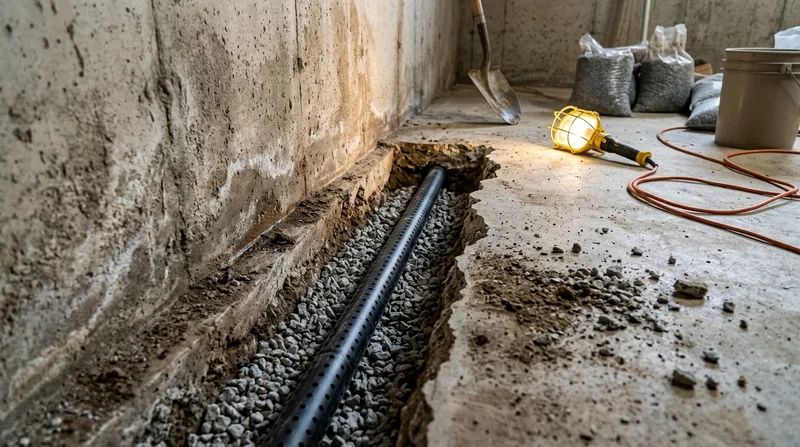



Boulder sits on heavy clay and shale that swells with every wet season and shrinks hard under the mountain sun. In Whittier and Mapleton Hill, 1900s bungalows often sit on low stone or early block foundations, and water finds the slab edge fast. On the east side and in Martin Acres, 1950s ranches with partly finished lower levels show seepage after summer storms. Foothill homes in Gunbarrel and Niwot take fast runoff off the slopes. An Interior Drain Tile System in Boulder captures that water at the footing, channels it to a sump basin, and pumps it out before it reaches your floor. We install interior perimeter drains in any season, and we tell you plainly when a simpler repair is enough. Start with a free basement inspection so the diagnosis comes before the estimate.
Why Interior Drain Tile Matters in Boulder's Clay and Shale
Boulder Creek and its tributaries flood hard in heavy rain, and the foothills shed runoff fast after storms. That water pushes against basement walls as hydrostatic pressure, and glacial clay soil holds it there. Older homes in Goss-Grove and Whittier often have no working footing drain at all, so the water table rises into the wall and the floor seam. When you see efflorescence or a musty basement smell, the moisture is already moving through the concrete.
- Hydrostatic pressure pushes water through hairline cracks and the cove joint where the wall meets the slab.
- Freeze-thaw swings crack parging and open seams that looked tight in July.
- Hillside homes in Gunbarrel and Niwot collect runoff from the slope above the foundation.
- Older stone and block lower levels in Mapleton Hill wick water instead of shedding it.
- Downspouts that dump next to the foundation reload the soil every storm.
An interior perimeter drain relieves that pressure at the footing instead of fighting it at the wall surface, which is why it outperforms repeated crack sealing on wet clay.
Key info: A 1920s bungalow near Goss-Grove had water on the floor every June. The wall cracks had been sealed twice. The real problem was hydrostatic pressure at the footing, and an interior drain tile system with a sump basin ended the seepage. For the code side, verify drainage and discharge requirements with the City of Boulder permit office before work begins.
How We Install an Interior Drain Tile System in Boulder
We break out a narrow strip of slab along the perimeter, dig down to the footing, and lay perforated pipe in washed gravel with a filter fabric wrap. The pipe runs to a sump basin set at the low corner, and a sump pump with a check valve pushes water out through the discharge line. We backfill, pour new concrete, and leave the floor level and clean. The sequence matters because we set grade before the slab goes back.
- We inspect the basement, map the wet zones, and check the footing depth and wall condition.
- We cut and remove a 12 to 16 inch strip of slab along the wall and excavate to the footing.
- We set the sump basin at the lowest point and core the discharge line through the wall or rim.
- We lay perforated drain tile in gravel, wrap it in filter fabric, and tie it into the basin.
- We install the sump pump, check valve, and discharge line, then test with water before backfill.
- We backfill with gravel, pour new concrete, and clean the work area.
On a Martin Acres ranch, the low corner sat under a finished rec room, so we ran the tile to a basin tucked behind a utility wall and kept the finished floor intact. Pair the drain with a sump pump installation sized to the inflow, and add a battery backup if the basement holds anything you cannot lose in a storm outage.
Key info: A split-level in Gunbarrel took slope runoff through a window well and across the slab. We tied the interior drain to a new basin and added a window well drainage fix on the uphill side. The floor stayed dry through the next July storm.
Interior Drain Tile Approaches We Use in Boulder
Not every basement needs the same layout. The wall material, footing depth, and how the water enters decide whether we run a full perimeter loop or a partial run on the wet side. The table below shows the approaches we install most in Boulder County and what each one solves.
| Approach | Description | Best for |
|---|---|---|
| Full perimeter interior drain | Perforated pipe along all four walls feeding one sump basin. | Wet clay sites and basements that seep on more than one wall. |
| Partial run on the wet side | Drain tile along the uphill or creek-facing walls only. | Hillside homes in Gunbarrel and Niwot with one wet wall. |
| Drain tile plus dimple board | Drain tile with a dimple board membrane on the wall face. | Stone and early block walls in Whittier and Mapleton Hill. |
| Sump basin and pump upgrade | New basin, cast iron or thermoplastic pump, check valve, discharge line. | Existing drain tile that backs up or has no working pump. |
| Drain tile repair and reconnection | Replacing crushed or clogged runs and reconnecting to the basin. | Older systems silted up after years of clay fines. |
We choose the layout after we see the footing and the water, not from a phone description. If the existing tile is silted or crushed, a drain tile repair may be the whole job.
Interior Drain Tile System Cost in Boulder: What to Expect
Most interior drain tile work in Boulder starts around $50 per linear foot, and that figure covers the slab cut, excavation to the footing, gravel bed, perforated pipe, and concrete patch. A sump basin and pump add to the total, and a full perimeter on a large poured basement costs more than a partial run on a small 1950s ranch. Access matters too: a finished basement with a low ceiling takes longer than a bare one. Get two or three written estimates so you can compare scope, not just the bottom line. Our pricing overview breaks down the line items.
- Linear footage of wall to be drained is the biggest driver of the price.
- Sump basin, pump, check valve, and discharge line are quoted as a package.
- Finished floors and tight access add labor on remodels and older bungalows.
- Hillside sites in Gunbarrel and Niwot may need extra discharge routing.
- Permit fees vary by jurisdiction and are separate from the installation price.
An estimate that looks cheap usually leaves out the pump or the concrete patch, so compare the scope line by line before you sign.
Interior Drain Tile System Near Me: How to Vet a Boulder Contractor
When you search for an interior drain tile system near me in Boulder, the list of names can look the same. The difference shows up in the license, the insurance certificate, and whether the crew explains the diagnosis before the quote. Ask for the certificate of insurance and confirm the license, then call two references from jobs at least a year old. Get two or three written estimates with the scope spelled out, and ask who pulls the permit. Rules vary by jurisdiction, so confirm drainage and discharge requirements with the local building department.
- Confirm the contractor is licensed and insured and ask for the certificate.
- Request at least two references from basements similar to yours.
- Get two or three written estimates that list pipe, gravel, basin, pump, and patch separately.
- Ask who pulls the permit and whether discharge routing is included.
- Read the warranty terms and confirm they are transferable.
Reach us through the contact page to schedule a free inspection and a written scope. We tell you when a simple crack repair is enough and when the pressure calls for a full interior drain.
Interior Drain Tile System in Boulder: Pricing Guide
| Service | Price | Details |
|---|---|---|
| Partial interior drain run | Starting at $50/linear ft | Covers slab cut, excavation to footing, gravel, pipe, and concrete patch on the wet wall. |
| Full perimeter interior drain | Starting at $55/linear ft | All four walls tied to one basin, with pump, check valve, and discharge line included. |
| Sump basin and pump package | Starting at $1,200 | Basin, pump, check valve, and discharge line, priced by pump capacity and discharge length. |
| Drain tile repair and reconnection | On estimate | Crushed or silted runs need a camera look and an on-site scope before a number is given. |
| Travel | Included | In Boulder and surrounding areas, no separate call-out or mileage fee. |
| Estimate | Free | Response within 24h at (970) 670-8043, no obligation to book. |
Indicative pricing, the exact cost depends on square footage, finish, and site access. Free personalized estimate within 24h at (970) 670-8043.


